Georges de La Tour
Paris. Last week, in the baroque pile of a mansion that is Musée Jacquemart-André, I visited the Gorges de La Tour show with Sean and Aisha, and we’ve been discussing it ever since. The topic of the conversation hasn’t been so much the intrinsic quality and nature of the work, but rather what it did to us. It’s one of those shows that both renews your faith in art and, as an artist, makes you cringe at what you have so far put out in to the world.
The thing I kept coming back to was this sense of attention that had been invested into the works. You could feel it. These paintings, pre camera obscura, are so modern in what has been included and what has been left out, they have truly been composed, not just fleshed out, and they feel so alive, so full of perfect deft details. Attention has just been spilled and poured into them. The subjects of the paintings have been looked at deeply, understood on some fundamental level, and then translated into paint – a snagged thread on an apron might be pulled out with one simple brush stroke, while the undulations of light and shadow on the shoulder strap are so perfectly rendered that you can hardly see any evidence of stroke, direction, or layering at all. And the Shadows! La Tour is renowned for the use of candle light, but the shaded areas for me were almost more important than what was caught in the light. They are warm dark reds, more saturated than the cooler highlights, so that the whole thing glows.
As someone who works mostly with photography I was immersed in his sense of colour balance, of how one tweaks saturation, tone, and brightness in the highlights mid-tones and shadows respectively. There’s a point when balancing these levels where a photo suddenly gels together, where it goes beyond pure reproduction and captures atmosphere, and a coherent sense of space, and these paintings do exactly that, without the convenience of dragging some sliders around on a screen until it feels right.
So, to observe this mastery unfold in every small detail, every corner, was a balm, and also left me asking myself, how can I possibly devote that much attention to anything? How can anyone right now? And not just because the internet has destroyed our ability to maintain focus etc., but because to live in society today on a base level requires a fragmentation. For myself, I work full time, I juggle different obligations, I’m rarely in the same place two weeks in a row, and I feel like I’m only ever making art in grabbed moments, in intense sprints, even if I’m thinking about it constantly. The ability to devote that much attention to any subject matter feels impossible. Even if I was loaded and had a clear six months, I think the very conditions needed to make work with this level of consistent attention over long periods of time don’t, and can’t, exist within whatever level of capitalism we are now on. To put it bluntly, on a high level if it’s not the collapse of democracy it’s the collapse of the environment intruding on your peace, and on a close level it’s rent and tax returns and bureaucracy and so on.
I saw the La Tour show the same week all the art fairs were on in Paris. I went to one of the main fairs, and though the standard of work was pretty good, I could just sense this lack of attention everywhere, all around me. Everything looked and felt like a first pass, thin preparatory work before the real thing gets made. I struggled to feel anything for anything, and defaulted to looking for trends and recognising names. I quickly felt drained, like I’d been on an Instagram bender. My friend Moises said afterwards, there was too much of too little, and I think that sums it up, and maybe sums up a larger problem with contemporary art right now.
I can level all this criticism at my own work too, before it seems like I’m passing down a judgement. In fact I don’t hold artists to blame for this thinness, maybe a little bit maybe, but I think most of us are always making art right down to the line. In the forum we work in, in order to keep it going, we have to keep producing, even when the art could really benefit from a period of rest and reflection. Productivity is the name of the game.
I believe the drive to make art, at its base, is still as mercurial, mysterious, and pagan as it ever was, but we have to plug our creative urges into a system, at least here in the west, that can only see, can only understand things, in terms of productivity; Rather than valuing deep attention invested in the production of art, instead today we demand art that grabs our attention, iteratively, repeatedly, in succession. I think art is, on the whole, a slow medium, and right now it is trying to act like a fast one.
I also went to see the Richter show at Fondation Louis Vuitton, and I was excited to get my teeth into it as some kind of counterpoint. I spent a lot of time thinking about Richter in my early twenties, reading his published notebooks. Even though his work can leave me cold at times, I’ve always appreciated the intellectual project behind Richter’s work. If La Tour was the master of paying attention to subject matter, Richter is the master of thinking about painting through painting. I thought the show would give me something modern and contemporary that would engage me as much as the La Tour show did, but in a different way, giving me hope that a different paradigm of attention could exist.
Well, I really dislike that building, the Louis Vuitton foundation, built by Gherry. It’s like they did everything they could to turn the experience of looking at art into one of queuing at an airport. We had to wait for 30 minutes in the rain to get through security. I queued 10 minutes to go to the bathroom because there were only two. They oversold the show so you are just shuffling in a line. They have barriers up in front of every work so far from the walls that you have to bend over them to look at any details, but then you set off an alarm, so as you shuffle through, looking at the work from awkward standpoints, alarms constantly go off in surround sound. I was so angry I couldn’t engage. And the proportions of the spaces inside are weird, too big and too small at the same time, windowless, bearing no relation to the free form exterior. It was a shame. The whole thing felt like a hubristic extravagance that wasn’t intended to facilitate any visitors. I came away feeling like it was all about money, in the end, even the Richter’s somehow, and in this instance it made it impossible to engage with the work, there was just too much in the way, the experience too loaded with faff and churn.
I’ve included this trip to the foundation because it felt like an analogy to what I’m trying to get at. Even if the attention is there in the work, which I think it is in Richter’s, the context and environment in which the work has to exist negates any meaningful interaction with that attention.
The whole week, seeing the La Tour show, and then the art fair and the Richter, left me in a bit of a spin. The contemporary art world feels like it’s chasing something, trying to be fast instead of slow, and in the current context where public and institutional funding has been cut drastically, and the market is collapsing, it’s chasing money, and when you are in a chase, there is no time or space for dedicated attention.
There’s no neat ending to this, just the question: in today’s context, how can we do a Geroges de La Tour?


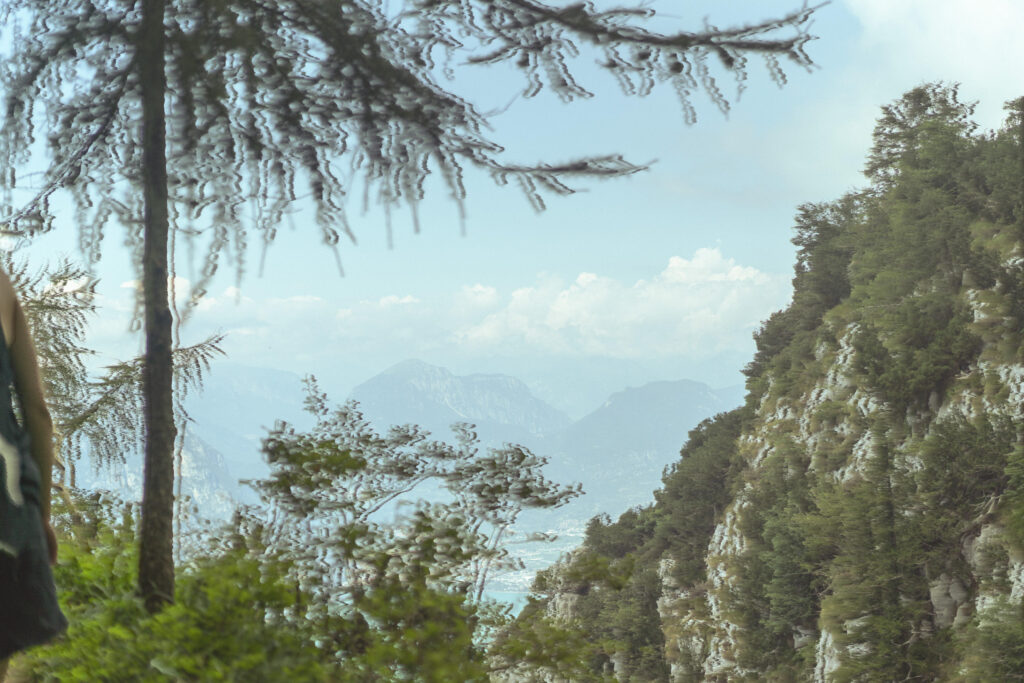
detail images courtesy of Sean Crossley
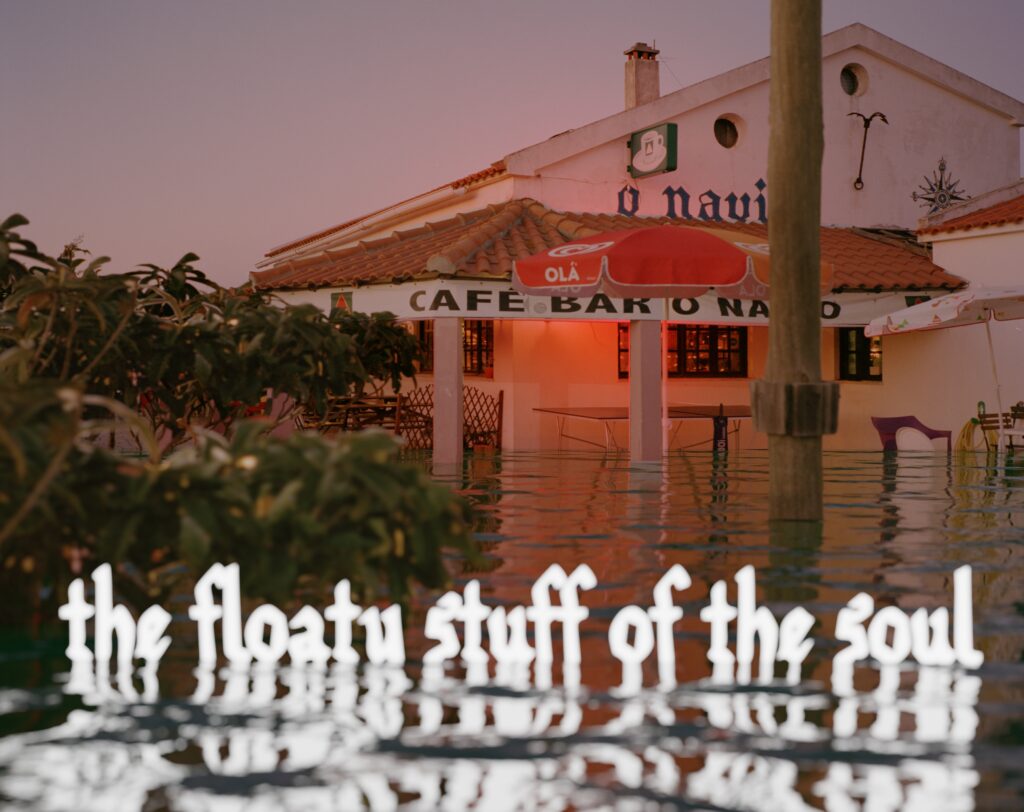
Pixel sorting and image manipulation using Python scripts
I had this idea about five years ago to write my own pixel sorting scripts. What’s pixel sorting I hear you say? In it’s most basic form, it’s taking the pixels in an image and resorting them according to values such as brightness, saturation, colour etc..
If you think of pixels in an image existing in columns and rows, a simple script would say: go from column to column, top to bottom, when you hit a pixel that has a brightness value of 150 (pixels have a brightness value of 1-255), take the next 10 pixels, and put them in an ascending order according to their brightness. This creates cool glitchy trailing pixel effects. There are lots of pixel sorting scripts that people have shared out there on the web, so it’s not like you need to know how to code to do it. But I wanted more control and I could see how I could add layers of complication if I could just fucking code. So I started learning Python; quickly gave up.
It’s super interesting, coding. Using logic in that way scratches a lot of itches for me in terms of problem solving, but I just don’t have the brain for it. Sometimes you have to admit defeat, move on with your life. Fast forward to 2025.
I still don’t know how I feel about AI (you can see where this is going). I found the initial wave of generative image stuff fascinating, like completely enthralling. Not just because of its eerie weirdness, the horrible fingers, the faces of horror; it just blew me a way. I had a lot of fun running a fake instagram account that was a parody of myself using generated images. But what was fun about it was the captions I was writing, it gave me an outlet for some creative writing, the images themselves quite quickly lost their appeal, their sense of wonder. Then the internet became flooded with AI dross, and I didn’t feel like contributing more to it, so I put it on pause. Now I feel like I can’t walk down the street without an AI generated human with extenuated features maniacally grinning at me from every poster. I hate the fuckers.
There are of course lots of concerns around AI, copyright, energy use, job losses. I actually lost a small illustration gig I had with a microbrewery to AI generated versions of what i was doing. So yeah, it’s real. But it’s also here for good, and I think it’s worth trying to understand what we are dealing with through, er, indulging in a bit of AI implementation ourselves.
SO, armed with the latest ChatGPT model, I was finally able to write the python scripts I dreamed about five years ago. And wow, as a tool, it is very very useful and powerful.
- Ok quick note, my biggest insight through using AI is that it is incapable of producing something in and of itself that has cultural meaning and value beyond being in some manner ‘strange’ or ‘pretty’, it’s always surface level. AI has no consciousness or subjectivity, it can only give us poor reflections. However, it is amazing at language, that’s all it is, so any task that is based around structuring meaning, such as coding, it is very very good at.
I started with basic scripts, I don’t think it has ever given me a script that worked perfectly off the bat, but with my very basic knowledge of Python I was able to either spot the problem and correct it, or tell it what was wrong and get it to correct it. Through using ChatGPT to write these scripts I’ve grown to understand Python on a level I couldn’t before, even though I’m not sure I’ve learned any extra code, which is interesting. I’ve been able to build up the layers of complexity and, well, here are some of the results. These are still just experiments, but I get very engrossed in making them, the element of chance that is introduced into the composition is somehow like taking photos, you’re never sure of the results until they’ve been processed but you’re ever-present as you’re hunting for that image.


Jeff Mills on the 909
I come back to this video all the time. It’s not just the proficiency, it’s the way playing something technological, programmable, as a live instrument leads to these beautiful hand movements, a sense of pure flow and intuition.
My brother in law first showed me this video. He said Jeff Mills live sets were some of the most absorbing, lose-yourself-in-the-music nights he’d ever had.
Sad Diplomats
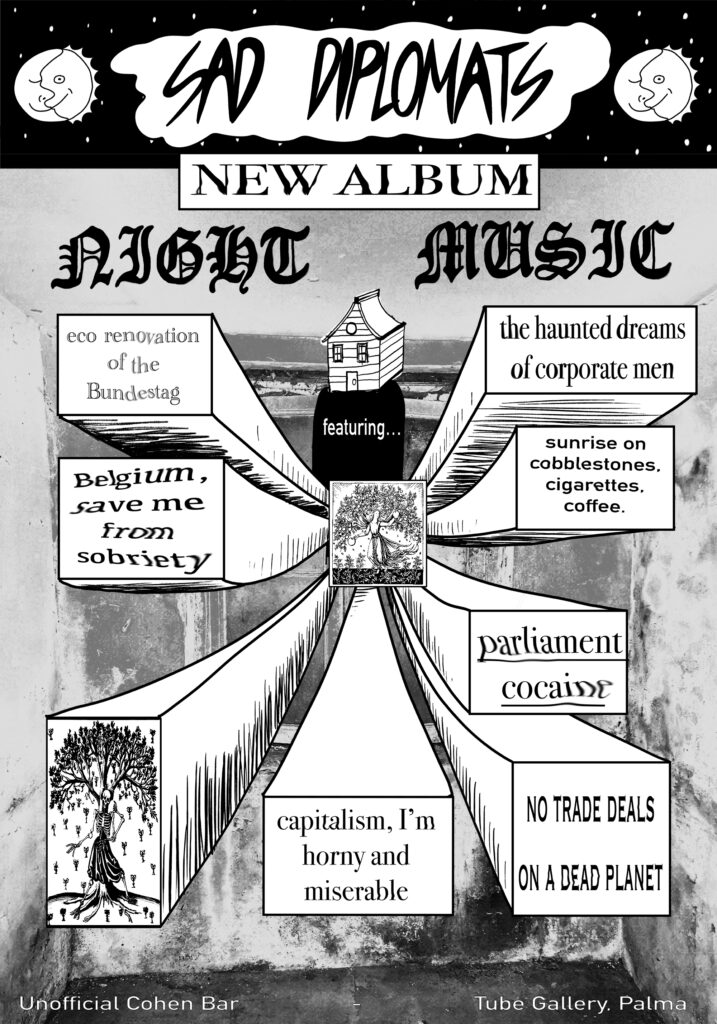
A poster i made to be in the exhibition Ubiquitous no.14 at Tube Gallery in Palma, Mallorca, curated by Elaine Tam